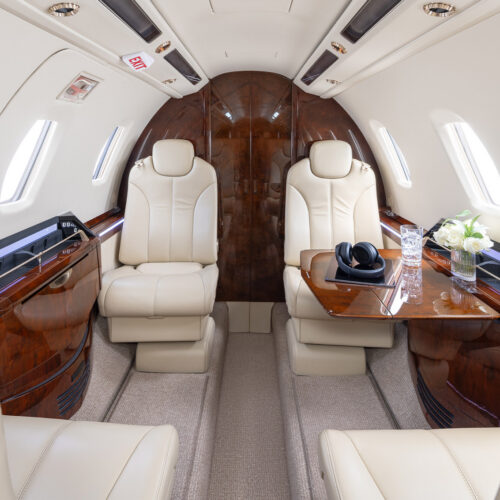
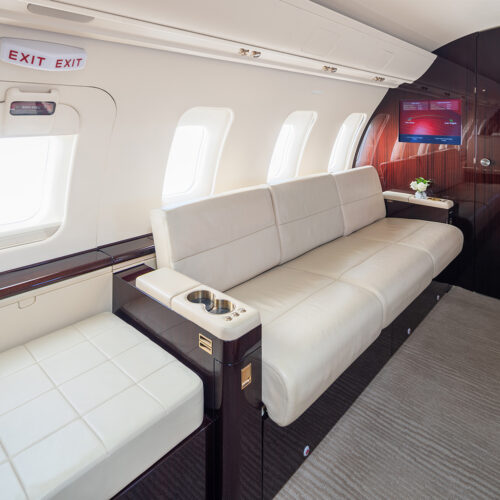
A private jet charter for a large group usually means one of two things: several business jets flying as a coordinated set, or a single airliner-size aircraft. In the U.S., the dividing lines are set by regulation: on-demand charter jets are limited to 30 passenger seats, any aircraft with more than 19 passenger seats must carry a flight attendant, and anything larger than 30 seats is flown by a different class of carrier.
This guide explains which aircraft fit which group size, when two or three jets beat one big airplane, how per-passenger taxes scale with headcount, and what to settle before you request a quote.
Most business jets seat 6 to 16 passengers. Once a group grows past what one large-cabin jet holds, the planning changes: you are choosing between splitting the group across aircraft and moving everyone on one airframe. In practice, operators and planners tend to think in four bands.
| Group size | Typical solution | Example aircraft | Main trade-off |
|---|---|---|---|
| 10–16 | One large-cabin or ultra-long-range jet | Challenger 605, Gulfstream G-IV SP, GV, Global Express | Simplest option; check baggage weight on long legs |
| 15–40 | Two or three business jets flying together | Mix of super-midsize and large-cabin jets | More flexibility and redundancy; group is split in flight |
| 16–19 | One of the largest business jets | Airliner-based business jets such as the Embraer Lineage 1000 | Everyone together; few aircraft available, longer lead time |
| 31 and up | An airliner flown by a supplemental (Part 121) or foreign air carrier | VIP-configured or standard narrow-body and wide-body airliners | Highest capacity; larger airports and earlier booking required |
The bands overlap on purpose. A 14-person executive team can fly comfortably on one large-cabin jet for a two-hour hop, but the same group on a long overwater leg with ski bags or production cases may need a second aircraft for weight and comfort.
The 30-seat line. Under the FAA definitions in 14 CFR 110.2, on-demand charter covers airplanes with a passenger-seat configuration of 30 seats or fewer and a payload of 7,500 pounds or less. Airplanes with more than 30 passenger seats, or more payload, fall under “supplemental” operations, which require a different, airline-style certificate. That is why most Part 135 charter operators, Silver Air included, do not fly airliners with 50 or 150 seats.
The 19-seat line. 14 CFR 135.107 says a certificate holder may not operate an aircraft with more than 19 passenger seats (excluding pilot seats) without a flight attendant on board. Many large-cabin business jets carry a cabin attendant anyway, but above 19 seats it is a legal requirement, not an option.
Why it matters to you. If someone offers a 60-seat aircraft, ask which certificate it flies under and who holds operational control. A legitimate answer names the carrier and its certificate type. Our guide to operator vs broker operational control explains what to look for.
Choose one aircraft when the group must arrive together, the trip is a single long leg, the destination airport can handle the type, and the group is above roughly 30 people, where splitting across jets becomes hard to coordinate.
Choose several jets when the group is between about 15 and 40 people, people need to leave at different times or from different cities, you want to use smaller airports closer to the venue, or you want a backup: if one aircraft has a mechanical delay, part of the group still travels while recovery is arranged.
Split the group sensibly. Keep decision-makers on separate aircraft for corporate travel if company policy requires it, put the bulk of the baggage on the aircraft with the largest hold, and give each jet its own lead passenger who has the manifest and the ground transport plan.
Watch the airport. Business jets can use thousands of general aviation airports. Airliner-size aircraft need longer runways, compatible ground equipment and FBO space for a crowd, which can push you to a larger airport farther from where you are going.
Charter pricing for the aircraft itself depends on the route, dates, repositioning and overnights, but U.S. federal taxes add a per-person element that grows with headcount. According to the FAA’s summary of 2026 aviation excise tax rates, domestic commercial flights carry a 7.5 percent ticket tax on the transportation charge plus a flight segment tax of $5.30 per passenger per segment. International arrivals and departures carry a separate per-passenger tax of $23.40 in 2026.
A quick illustration. One jet with 12 passengers on one domestic leg owes 12 × $5.30 = $63.60 in segment tax. Three jets carrying 40 passengers on the same leg owe 40 × $5.30 = $212.00 for that leg, before the 7.5 percent tax on each aircraft’s charter price. On a four-leg tour, those segment charges repeat on every leg.
The bigger cost lever is usually the number of aircraft and how far each has to reposition. For an all-in quote on a specific itinerary, the Silver Air charter team quotes at (800) 889-5840. Our charter cost guide by aircraft category shows how each jet class is priced.
Leadership offsites and board meetings. Executive teams that need to arrive rested and keep conversations private.
Weddings and milestone events. Families and guests flying into resort destinations where commercial service is limited.
Corporate incentive trips. Top performers and partners, often to Mexico, the Caribbean or ski towns.
Sports and entertainment. Teams, artists and crews on tight schedules; our sports team and tour charter guide covers those itineraries in detail.
Silver Air is an FAA Part 135 operator founded in 2008 in Santa Barbara, California, and it holds Wyvern Wingman PRO certification. Its managed fleet runs from the Pilatus PC-12 and Citation CJ3 up to the Challenger 605, Gulfstream G-IV SP, GV, G550 and Global Express. On the Silver Air fleet page, the Challenger 605 is listed for 10 passengers and the G-IV SP, GV and Global Express for 12 to 14.
That makes Silver Air a strong fit for groups of roughly 10 to 40 people who want one operator, one operations team and one standard across every aircraft, flown under its own operational control. Because Silver Air does not operate airliners, a group that must travel together in one 50- or 100-seat aircraft needs a supplemental or foreign air carrier; the charter team can talk through whether a multi-jet plan or an airliner is the better fit for your trip. Start at Silver Air charter or call (800) 889-5840, available around the clock.
What is the best private jet for a large group?
For 10 to 16 people, a large-cabin jet such as a Challenger 605 or Gulfstream G-IV SP is usually the simplest choice. For 15 to 40, two or three jets flying together often work best. Above 30 passengers, you need an airliner flown by a supplemental or foreign air carrier.
How many people can fit on a private jet?
Most business jets seat 6 to 16. Business-jet versions of airliners can seat more, but U.S. on-demand charter is limited to 30 passenger seats and 7,500 pounds of payload under 14 CFR 110.2; larger aircraft fly as supplemental operations.
Is it cheaper to charter one large aircraft or several smaller jets?
It depends on where the aircraft are based, the airports you need and the group size. Several jets can cost less when they are positioned nearby and can use airports closer to your destination; one aircraft often wins above about 30 passengers. Compare all-in quotes for both.
How far ahead should we book a group charter?
As early as the itinerary is firm. Multi-aircraft trips and peak dates such as holidays and major events need the most lead time, because several suitable aircraft must be free at the same time.
Do private jets charge taxes per passenger?
Yes, for domestic U.S. charter. In 2026 the federal segment tax is $5.30 per passenger per segment, on top of the 7.5 percent ticket tax, according to the FAA’s 2026 excise tax summary.
Will a flight attendant be on board?
Aircraft with more than 19 passenger seats must carry one under 14 CFR 135.107. On smaller large-cabin jets, ask the operator; many long-range trips include a cabin attendant.
Can a group with different departure cities still charter together?
Yes. Multi-aircraft charter lets each jet start where its passengers are and meet at the destination, which is often faster than gathering everyone at one airport.
Reviewed November 21, 2026 by the Silver Air team.