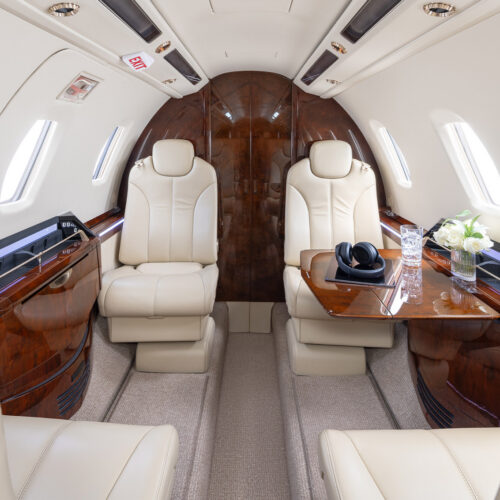
Private charter beats first class when the real cost of a business trip is time rather than the ticket: several stops in one day, three or more people traveling together, a destination far from an airline hub, or conversations that must stay confidential. Business aircraft can use roughly 5,300 public-use airports in the U.S., while commercial airlines serve about 550 of them, according to the National Business Aviation Association (NBAA), so a charter can often land minutes from the meeting instead of a two-hour drive away.
For a single traveler on a well-served nonstop route, first class is usually the better value. This guide covers what makes a trip outgrow first class, how time and cost compare, and the questions to ask before you choose.
Most executives don’t move to charter because of comfort. They move because the airline network stops fitting the trip. The common triggers:
Multiple cities in one day. Two or three meetings in different cities is often impossible on airline schedules without overnight stays. On a charter, the aircraft waits and the itinerary is built around the meetings.
Traveling as a team. When three or more people travel together, the cost of a charter is shared and the per-seat gap with first class narrows.
No good nonstop. Thin routes, connections through a hub, or a final destination served only by a regional airport add hours that a first-class seat doesn’t fix.
Timing tied to a deal. When a meeting runs late or a closing moves, an airline seat can mean an unplanned hotel night. A charter leaves when you are ready.
Confidentiality and security. Sensitive discussions, a controlled passenger list, or a personal security profile can rule out a commercial cabin regardless of price.
Private charter often saves executives two or more hours per trip compared with first class once airport processing is counted. First class still means hub airports, check-in, security queues and boarding, which routinely take 90 minutes or more before departure; priority lanes only trim that.
Private terminals (FBOs) work differently: passengers typically arrive about 15 minutes before departure, walk to the aircraft and are airborne quickly, then leave the airport minutes after landing. On a round trip or a multi-stop day, the saving compounds, and for leadership teams those recovered hours are often the point of the trip.
For most single-traveler trips, first class costs less. The comparison changes when several travelers share the aircraft, when the itinerary would otherwise need extra hotel nights or connections, and when lost working time is counted. Charter is priced for the whole aircraft, so cost per seat falls as the group grows; our guide to private jet charter cost by aircraft category shows current hourly ranges, taxes and fees for each size of aircraft.
The hidden costs of commercial travel, such as hotel nights forced by connection schedules, lost working hours and delayed deal timelines, rarely appear in a simple ticket comparison. First class does offer more predictable pricing: a fare is fixed, while a charter price depends on aircraft type, routing, repositioning, airport fees and crew costs.
Not every trip calls for private aviation. Jason Middleton, founder and CEO of Silver Air Private Jets, who still flies commercial himself on certain routes, puts it plainly: “I use private aviation as a tool. When it makes sense, it makes a lot of sense. When it doesn’t, there are great commercial options. The executives who get the most value out of it are the ones who think about it strategically, not reflexively.”
Private charter provides a confidential environment that no first-class cabin can match. In first class, conversations are audible to neighboring passengers, crew and anyone passing through. Sensitive M&A discussions, legal strategy or personnel decisions cannot safely take place there. On a chartered aircraft, the passenger list is controlled entirely by the booking party, and the cabin works as a mobile boardroom for document review and working sessions.
When geopolitical events or security situations arise, the value of a trusted private aviation relationship becomes especially clear. Silver Air has coordinated complex client evacuations during international crises, arranging armored ground transport, cross-border logistics and private flights to safe transit points within 24 hours. That level of response is only possible when an operator already knows the client, their priorities and how to move fast under pressure.
Charter departs on the executive’s schedule, not the airline’s. A deal that closes at 4 p.m. can mean wheels up at 5 p.m., not an overnight stay waiting for the first morning flight. And because business aircraft can use thousands of airports that have no airline service, an executive can fly directly into a regional airport near a client site, plant or project rather than routing through a hub. For trips that come up at short notice, see how urgent 24/7 charter works.
Solo long-haul trips. On transatlantic and transpacific routes for one traveler, flat-bed seats, lounges and onboard dining are hard to beat on cost, because long-range charter aircraft carry much higher hourly costs that nobody shares.
Well-served nonstop routes. If the trip is one destination and the airline schedule fits, the extra flexibility of charter may not justify the price.
Miles and points. Redeeming loyalty points for first class can sharply cut out-of-pocket cost. Charter has no equivalent, although some membership programs offer pricing benefits for frequent flyers.
For domestic U.S. trips and regional routes, the calculus reverses quickly, especially when multiple executives travel together or when schedule risk threatens a business outcome.
| Factor | First class usually wins | Charter usually wins |
|---|---|---|
| Travelers | One or two | Three or more sharing the aircraft |
| Itinerary | Single nonstop between major cities | Multiple stops, same-day returns |
| Destination | Major hub city | Regional airport near the site |
| Schedule | Fixed and flexible | Tied to meetings or a deal that can move |
| Privacy | Not sensitive | Confidential discussions or security needs |
| Price certainty | Fixed fare, points usable | All-in quote confirmed before booking |
Before defaulting to first class, executives and their assistants should answer four questions: How many people are traveling? Is the destination served by a regional airport closer than the commercial hub? What is the cost of a delayed or cancelled commercial flight to this deal? And does the conversation on board need to stay confidential?
One factor that rarely gets asked but matters significantly: how well does the company you book with actually understand aviation? A charter broker with no operational background may push to make a trip happen even when conditions don’t support it safely. Middleton has seen this play out at airports like Aspen, where a tailwind can make landing inadvisable, but a broker unfamiliar with the safety implications will pressure an operator to proceed anyway.
“A good broker will educate their clients,” Middleton says. “A great operator will say no when no is the right answer, and explain why.”
If the answer to any of those questions is material to the trip’s outcome, private charter deserves a serious look at the numbers, not a reflexive assumption that it costs more. Our guides on charter operators vs brokers and how to choose a charter operator for corporate travel go deeper. For frequent flyers comparing access programs, Flight Club’s membership shows how a refundable-balance model works.
Not all operators are equal. Beyond basic FAA Part 135 compliance, look for operators that hold third-party safety certifications such as IS-BAO and Wyvern Wingman Pro. These programs audit an operator’s safety management system, training protocols and organizational culture, going well beyond regulatory minimums. Silver Air holds both.
Is private charter always more expensive than first class?
Not when several travelers share the cost. A light or midsize jet carrying four to six executives can come close to first-class fares per seat on many domestic routes, especially once hotel nights and lost hours are counted. For one traveler on a long-haul nonstop, first class is usually cheaper.
When is private charter worth it for a single business trip?
When the trip is complex, time-sensitive, involves several passengers, or needs an airport commercial airlines don’t serve. For one person flying between two major cities, first class is usually the more cost-efficient choice.
How many airports can a private jet use compared with airlines?
The NBAA counts roughly 5,300 public-use airports in the U.S.; commercial airlines serve about 550 of them. That access often puts executives much closer to their actual destination.
How far in advance do you need to book a charter flight?
Domestic charters can often be arranged within hours when an aircraft and crew are available, but 24–48 hours gives far more choice of aircraft. International trips that need permits, and peak travel periods, benefit from several days or more of planning.
Can I use airline miles for private charter?
No. Points and miles are one of the strongest arguments for first class on well-served international routes; charter has no comparable loyalty system.
What aircraft are typically used for business charter?
Light jets for short regional trips, midsize and super-midsize jets for domestic and transcontinental travel, and large-cabin, long-range jets for nonstop international flights. The right one depends on passengers, distance, luggage and whether you need a working cabin.
Is private charter safe?
Charter aircraft operating under FAA Part 135 are subject to FAA oversight of the operator, its crews and maintenance. Look for operators with additional third-party audits such as IS-BAO and Wyvern Wingman Pro, and ask how they handle a trip when conditions don’t support the requested flight.
Source: National Business Aviation Association, “Airports” advocacy page (nbaa.org).
Reviewed November 19, 2026 by the Silver Air team.