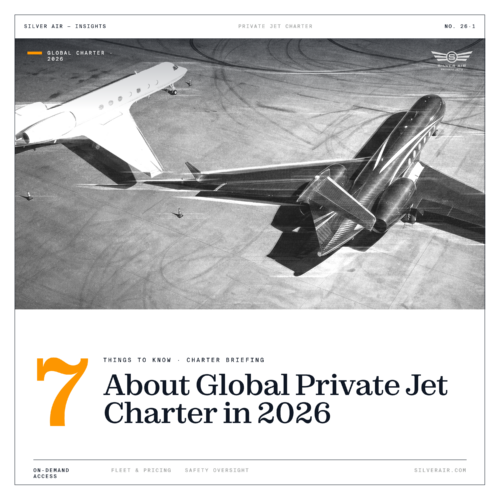
From pricing shifts to sustainability rules, here are the seven most important facts about global private jet charter in 2026 every traveler should know.
Global private jet charter in 2026 means booking a private aircraft for a specific trip, without owning a plane or holding a fractional share. Whether you’re flying domestically or internationally, private jet charter gives travelers the flexibility to choose the right aircraft, departure airport, and schedule for each mission.
Silver Air works with individuals, families, corporate flight departments, and organizations flying throughout North America and around the world. Here are seven trends every private jet traveler should understand in 2026.
How big is the global private jet charter market in 2026?
The private aviation sector has grown substantially coming out of the post-pandemic surge. According to WINGX, business aviation flight activity across Europe and North America remained well above pre-2020 levels through 2024 and into 2025, with charter flights accounting for a rising share of total movements as first-time fliers who entered the market during the pandemic continued to book. Industry analysts have projected the global business aviation services market — including charter — to be worth tens of billions of dollars annually by the mid-2020s.
Why are private jet charter prices stabilizing after years of sharp increases?
Rates are leveling off because supply has caught up with the post-pandemic demand spike. Operators expanded their fleets and crew rosters through 2023–2024, and that additional capacity is now exerting downward pressure on peak-season pricing. Travelers who saw light-jet transcon flights priced above $30,000 at the height of the boom are finding more competitive quotes in 2026, though prices remain above 2019 baselines.
At Silver Air, we’ve found that travelers who are flexible with departure times, airports, or aircraft categories often have more opportunities to reduce charter costs while still meeting their travel objectives.
What environmental rules are affecting private jet charter in 2026?
Sustainability compliance is becoming an increasingly important part of international private jet charter. The European Union’s ReFuelEU Aviation regulation, which is now in effect, requires minimum blends of Sustainable Aviation Fuel (SAF) at EU airports. The requirement applies to private jet charter operators just as it does commercial airlines.
According to the International Air Transport Association (IATA), SAF production capacity continues to increase, but supply constraints still mean SAF commands a significant price premium over conventional jet fuel. As a result, travelers flying to, from, or within Europe may see SAF-related charges reflected in their charter quotes.
How do you choose the right aircraft category for a global charter?
Choosing the right aircraft depends on four primary factors: trip distance, passenger count, luggage requirements, and budget.
For intercontinental flights, ultra-long-range jets such as the Gulfstream G700 or Bombardier Global 7500 are the dominant choice, capable of non-stop ranges exceeding 7,000 nm.
Our charter advisors help clients evaluate far more than cabin size. Airport access, runway length, passenger preferences, baggage, range, and overall trip cost all play an important role in selecting the right aircraft.
What should you look for when reviewing a private jet charter quote?
The lowest quote isn’t always the best value. Always scrutinize what is — and isn’t — included. A quoted price rarely covers all costs by default. Common add-ons can include:
A detailed charter quote should clearly itemize these costs so there are no surprises before departure. If a quote appears significantly lower than others, ask whether it includes repositioning costs, the aircraft’s return leg, international fees, and any applicable taxes or fuel surcharges.
Transparency matters. An experienced charter provider should be able to explain every line item, discuss available aircraft options, and help you understand the tradeoffs between price, flexibility, and convenience before you book.
How has booking technology changed the private jet charter experience?
Instant quoting platforms have become standard, but their accuracy varies. Dynamic pricing engines now pull live fleet availability to generate quotes in seconds, and some platforms offer app-based trip management from booking through landing.
Technology has made booking simpler, but it hasn’t eliminated the need for experienced charter advisors. Complex itineraries — including multi-leg international trips, last-minute schedule changes, group charters, or routes requiring special permits — still benefit from a human broker who can negotiate rates and manage logistics. Flight Club’s charter resources provide further context on how the booking process works for different types of private jet travel.
Is private jet charter actually accessible to non-ultra-high-net-worth travelers in 2026?
Increasingly, yes — for the right routes and group sizes. Empty-leg flights (repositioning flights sold at steep discounts, sometimes 50–75% below retail) remain the most accessible entry point. Shared charter and semi-private cabin models have also expanded, effectively lowering the per-seat cost on popular routes.
For families, business teams, or groups traveling together, chartering an entire aircraft can sometimes be more competitive than many people expect. Depending on the route, travel dates, and aircraft selected, the total cost of a midsize jet divided among six passengers may approach—or in some cases compare favorably with—the combined cost of six last-minute business class airline tickets, while also providing greater flexibility, privacy, and significant time savings.
—
Frequently Asked Questions
What is global private jet charter? Global private jet charter is the on-demand rental of a private aircraft for a specific trip, with no ownership or long-term commitment required. You pay for the flight, and sometimes a broker fee, and the operator provides the aircraft, crew, and handling.
How much does it cost to charter a private jet internationally? International private jet charter costs vary based on the aircraft, route, flight time, airport fees, and seasonal demand. A transatlantic midsize-jet charter might range from roughly $60,000 to $120,000 or more depending on routing, peak demand, and included services. Per-hour rates for light jets typically run $3,000–$6,000, while heavy jets can exceed $10,000–$15,000 per flight hour.
Are private jet charter flights subject to the same safety regulations as commercial airlines? Yes. In the United States, charter operators fly under FAA Part 135 regulations, while operators in other countries are regulated under their respective civil aviation authorities. These regulations govern aircraft maintenance, pilot qualifications, crew training, operational procedures, and safety management. Before booking, travelers should confirm that the operator holds the appropriate certifications and ask whether it participates in independent safety auditing programs such as WYVERN or ARGUS.
What is an empty-leg flight and how do I find one? An empty leg is a repositioning flight an aircraft must make with no passengers, to pick up the next charter client or return to base. Operators and brokers sell these at large discounts — sometimes 50–75% off — to offset the cost. They are best suited to flexible travelers, since schedules can change or be cancelled at short notice.
Is it cheaper to charter a private jet or fly first class? It depends on the number of travelers, the route, and the flexibility required. For individuals, commercial first class is usually less expensive. However, for larger groups traveling together, private jet charters can sometimes be surprisingly competitive when the total cost is divided among passengers. Private aviation also offers benefits that commercial airlines cannot, including direct access to thousands of additional airports, flexible scheduling, greater privacy, and significant time savings.
FAQ
What is global jet charter?
Global jet charter is the on-demand rental of a private aircraft for a specific trip, with no ownership or long-term commitment required. You pay for the flight and the operator provides the aircraft, crew, and handling.
How much does it cost to charter a private jet internationally?
Costs vary widely by aircraft type and route — a transatlantic midsize-jet charter might range from roughly $60,000 to $120,000 or more, while per-hour rates for light jets typically run $3,000–$6,000.
Are charter flights subject to the same safety regulations as commercial airlines?
Yes — charter operators flying under Part 135 (US) or equivalent AOC frameworks elsewhere are subject to rigorous civil aviation authority oversight covering maintenance, crew training, and operational limits.
What is an empty-leg flight and how do I find one?
An empty leg is a repositioning flight sold at steep discounts (sometimes 50–75% off) because the aircraft must fly without passengers. They suit flexible travelers, as schedules can change or be cancelled on short notice.